Ancient Astronaut Theory: What It Claims, What It Does Not
Where the theory came from
Three dates matter. In 1966 the astronomers Carl Sagan and Iosif Shklovskii published Intelligent Life in the Universe, which treated contact with Earth in the distant past as a hypothesis worth examining. In 1968 Erich von Däniken published Chariots of the Gods?, which turned the hypothesis into a bestseller and a brand. In 1976 Zecharia Sitchin published The 12th Planet, which read the Sumerian tablets as a record of visitors called the Anunnaki. Ancient Aliens, the television series, arrived on April 20, 2010 and has run ever since.
By 1979 Sagan was the theory's best known critic, in Broca's Brain. That arc, from a hypothesis a serious astronomer would entertain to a thing serious people felt obliged to distance themselves from, happened in thirteen years, and the examples never changed. What changed was who was making the argument and how carefully.
What it claims, and what it does not
The popular version claims that visitors built or directed the building of the great monuments, that they were worshipped as gods, and that the texts describing gods in the sky are literal reports. That is the version on television, and it is the version archaeologists reject, with reason, because it assumes the people who built those monuments could not have done it themselves.
The serious version does not claim that. It makes no argument about who moved the stones. It asks what specific texts and artifacts actually describe, and whether the conventional reading accounts for all of it. Those are different claims. The first can be dismissed by showing how a pyramid was built. The second cannot, because it was never about the building.
Ancient Aliens to Modern UFOs follows seven threads through the ancient record: the Sumerian tablets and the Anunnaki, Egyptian monuments aligned to the stars, the Amarna period sculptures from the reign of Akhenaten, around 1353 to 1336 BCE, with their elongated skulls, Ezekiel's wheels within wheels, Hindu scripture on celestial beings and their vehicles, Quranic references to celestial beings, and the Nazca Lines, which can only be seen whole from the air. The guide names them. The book takes each one through the same three questions: what it says, what the standard explanation is, and what that explanation leaves out.
| Question | This guide | Ancient Aliens to Modern UFOs |
|---|---|---|
| What ancient astronaut theory is and where it came from | Yes | Yes |
| The difference between the popular claim and the serious claim | Yes | Yes |
| Which seven ancient threads the book follows | Named only | Yes |
| What the Sumerian tablets actually say about the Anunnaki | No | Yes |
| The star alignments, with the measurements | No | Yes |
| The Amarna skulls, and the explanations offered for them | No | Yes |
| Ezekiel's vision, line by line, and the engineer who rebuilt it | Mentioned | Yes |
| What the Hindu and Quranic texts describe, in their own words | No | Yes |
| How the ancient record connects to Roswell, Nimitz, and the 2023 hearings | No | Yes |
What skeptics say, and what a serious reader does with it
Archaeologists make three objections, and they are good ones. The theory underestimates ancient people, who were as intelligent as we are and had centuries to practice. It cherry picks, lifting an odd carving out of a culture whose other ten thousand carvings are ordinary. And it argues from resemblance: this looks like a helmet, that looks like a rocket, as if looking like something were evidence of it.
A serious reader accepts all three and then notices what they cover. They answer the building question completely. They answer the resemblance question completely. They do not answer the text question, because a text is not a resemblance. When a tablet, a prophet, or a scripture describes beings descending in a vehicle, the question is not what it looks like but what the writer meant, and that is a question for translators and historians, not engineers. Which of the seven threads survive that test, and which do not, is the part this guide leaves for the book.
What people get wrong
- Treating the television series as the theory
- Ancient Aliens is one version, the loudest one. The theory is older than the show and narrower than the show in its serious form.
- Saying the theory claims aliens built the pyramids
- The popular version does. The serious version makes no claim about construction at all. It is about what the texts and artifacts describe.
- Assuming the skeptics have closed the whole question
- They have closed the engineering question. The text question is a different kind of question and needs a different kind of answer. The book takes it thread by thread.
- Calling it a religious claim
- It is a claim about the historical record. The book notes that confirmation would bear on religious assumptions, which is a consequence, not the claim.
- Thinking the subject ended with von Däniken
- The Pentagon has been releasing UAP records since May 2026. The book's argument is that the ancient end and the modern end are one record, and that reading either without the other is how people get it wrong.
Questions and answers
Is ancient astronaut theory the same as paleocontact?
Who started ancient astronaut theory?
Is ancient astronaut theory the same thing as the Ancient Aliens TV show?
What is the difference between the popular version and the serious version?
Does ancient astronaut theory say aliens built the pyramids?
Why are the Anunnaki central to ancient astronaut theory?
Why do people connect Ezekiel's vision to UFOs?
What three questions does the book ask of each ancient thread?
Is ancient astronaut theory a religious claim?
What do archaeologists say about ancient astronaut theory?
Did Carl Sagan believe in ancient astronauts?
What are the seven ancient threads in Ancient Aliens to Modern UFOs?
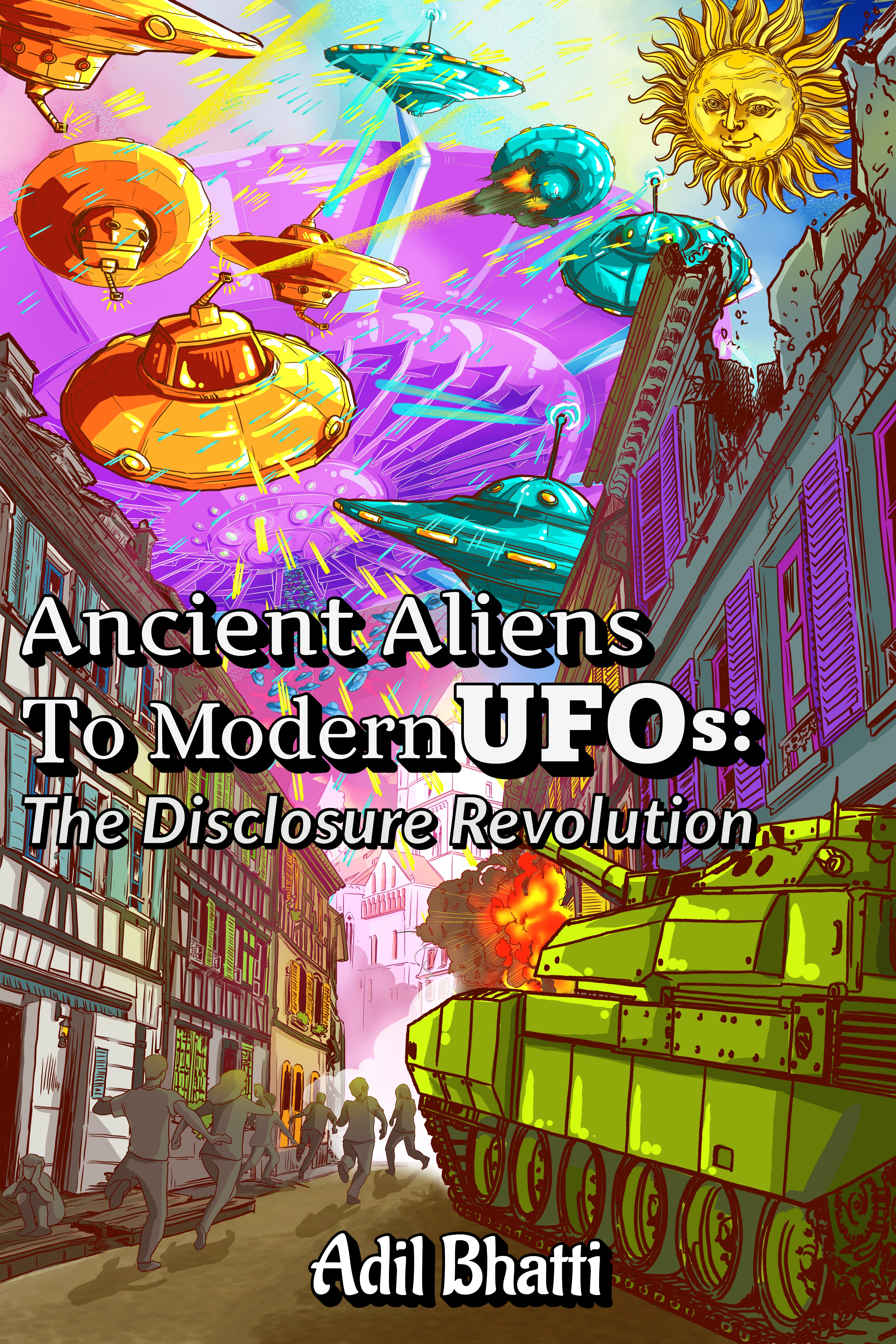
Ancient Aliens to Modern UFOs: The Disclosure Revolution
The ancient record is the first part of the book. The whole arc, from Sumerian tablets to the 2023 Congressional hearings, is the rest. Paperback, hardcover, and Kindle.